Sunday, March 27, 2011

Should I jump to the bandwagon of DM? What are the latest trends?

Marketing is undergoing a period of intense change as a consequence of the technological development we have been living, creating  what is so called digital revolution that has marked the new behavioural patterns of individuals.This digital revolution has created a new group of people that have been involved by this new technology: Digital Natives
In order to attract this new generation, marketers needed to enter in the digital world, creating new techniques; having to find new places where to stick advertising and becoming a very competitive market that tries to understand the audience.
All of us agree that the future seems to be full of new technological devices, which is one of the reasons why Digital Marketing is always evolving. But we cannot be sure of how is the future going to be but give our opinions of what we think it would be in 5, 10 or 15 years. In the next video Bonin Bough explains how he sees the future of marketing with all this new technologies.


According to MSN, the new media consumption landscape will be:

  • Media consumption will become less collective and more individual
  • Sophisticated, multiple pathways to individual consumers will develop
  • All media relationships will become interactive to a greater or lesser extent
  • Consumers will increasingly determine their own use of media in a much more complete fashion, including deciding when they will accept marketing messages and when they won’t
  • Metrics which measure ‘viewing’ rather than ‘engagement’ will disappear.
What is true is that no matter how these technologies will develop, we cannot stay stuck and we have to always catch up with what is coming, now we have to understand the new trends for this year and Dave Chaffey predicts what is coming for this 2011 creating a list with 11 of the most important trends:

Trend 1 Content / engagement strategy
The key to acquiring to costumers through SEO and social media is part of inbound. It’s also essential to keep customers engaged with a brand via different touchpoints like the website, “social outposts”, email marketing and apps. And of course, it’s not just text content, video content, podcasts, apps all to match all preferences. It’s been good to see increased attention on content strategy in 2010 with several new books on the topic. Since I believe it’s so important to success online, that’s why it’s Number 1.
Trend 2 Digital Marketing Optimisation
In the beginning there was search engine optimisation, then conversion rate optimisation and social media optimisation (hate that term). The analytical tools available to digital marketers enable analysis and optimisation of performance as provided by many agencies in these fields. Integration of toolsets through APIs and XML feeds has supported the growth of a rich set of free and paid tools. See the Google Analytics Application Gallery for the wealth of tools available.
Trend 3 Right Touching
Our prospects and customers increasingly use multiple channels when selecting products and services switching between digital media and traditional media. So it’s important to understand their preferences and facilitate switching from print to online and vice versa. Since outbound contacts are still vital in selecting the right print or email message frequency and message according to position in the lifecycle helps repeat sales. Smart companies have developed an automated email lifecycle with the right business rules to maximise engagement and sale.
Trend 4 Social media marketing
You may have heard of this… People don’t go online to “surf the web” today, they “Facebook”. Every company needs a Facebook strategy and the right resources to manage it unless their brand is so badly perceived it will do more harm than good. Nestle? For other companies, B2B? Twitter may be more important. We’ll look at some examples that show that success in an individual social media is achieved by understanding what you want to achieve from each channel, a clear idea of the value proposition and then resourcing it to deliver. But it’s underpinned by having the right content and touch strategies to integrate with other channels.
Trend 5 The resurgence of display advertising
Resurgence may be overstating it but many companies have found the newer remarketing and retargeting options available through established ad networks and Google’s new Adwords Remarketing feature effective. Using weighted attribution studies can also help establish the value of the display advertising halo effect.
Trend 6 Mobile Strategy
The growth in use of Apple App store has been phenomenal, increasing by several billions of downloads in 2010. Meanwhile other handset manufacturers are achieving success with apps, although Apple still has over two thirds of the market by download.
Trend 7 Googlization
In many countries, including the UK Google still drives the majority of traffic or it should if you get your SEO and PPC right. It’s increasingly important for generating awareness and display through the new Googled Display (formerly content) network too which in 2010 saw remarketing added. Google is so important for most pureplays that you could say you need a specific “Google Strategy”. A Google strategy requires an intimate understanding of your online marketplace or ecosystem. Oftentimes partnering, PR and contextual advertising can help you by thinking beyond your own SERPs position.
Trend 8 Online channel integration
With growth of importance of social media channels it has been suggested that email marketing is dead or less relevant. My belief is the two work best in an integrated way. To get ideas on the best strategies to achieve this I recommend signing up to Social Email Marketing.
Trend 9 Touchpoint attribution
Since online conversion to sale may occur over several site visits, it’s important to analyse and attribute sale to all of the channels that contributed, not just the last click. Online marketers have been grappling with this for a long time, but in 2010 these cases show that more companies got on top of this.
Trend 10 Privacy wars
Many of the keys to success online have a dirty secret – they rely on cookies. From Google Analytics to Remarketing to on-site personalisation, persistent cookies are needed to track and target behaviour.
But the media are intent on scaring consumers about threats to their privacy so unless marketers take action we’re going to lose some of the greatest benefits of online medias which will negatively effect marketers.
Trend 11 Digital marketing = Marketing?
We can no longer call digital media new now. With an increasing amount of media consumption and media spend migrating online, some are suggesting we don’t need a separate discipline of digital marketing, we don’t need separate digital strategies, but integration is the name of the game.
If you want to se the slide presentation he showed for Manchester University click here
What do you think guys do you agree with him or do you see more trends coming? see you next time ciaoo!

Sunday, March 20, 2011

The winning PITCH!!

A PITCHThe set of activities intended to persuade someone to buy product or take a specific course of action.


Having to pitch is not only about communicate your ideas it is about selling and convincing someone to trust on your idea.
A good pitch must contain the core information about your product (idea):
  1. What is about?
  2. Why it will appeal to audiences and which audience will appeal?
  3. Explain the producer’s information.
A good pitch must start with a punchy and easy-to-remember description so the audience can show interest through asking key questions. A catching slogan will work great, it will explain easily the main essence of the (K.I.S.S= Keep it short and simple).
Like every other assignment, a pitch has basic guidelines that must we followed:
  1. Keep it short.
  2. Try to paint a story through words.
  3. Have a back-up, in case what you are pitching isn’t suitable.
The structure of the Pitch.
Always formulate 3 levels of depth to pitching your idea: 5 seconds, 30 seconds, 5 minutes.
The 5 seconds version (elevator pitch) is the essence of your campaign, more o less like the short sentence that describes your campaign.
The 30 seconds version should include a brief description of your short sentences, and finally the 5 minutes version here you add the core of the paper or written proposal describing the next: how, giving the money and resources you need you will achieve your 5 seconds pitch.
And finally but not least important TEST IT!! Say the pitch to friends or people who are around you, this way you will get some feedback in order to improve your pitch.
Now go for it!! Show confidence and you will get it!
What other advice will you give to have a winning pitch?
Talk to you next week, ciaoooo guys.
 ---
http://www.investorwords.com/3706/pitch.html#ixzz1HBRkPtxh
Friedmann J. How to make money Scriptwriting. (2002). Intellect
http://www.scottberkun.com/essays/38-how-to-pitch-an-idea/

Saturday, March 12, 2011

MEASURES THAT IMPROVE CAMPAIGN PERFORMANCE


This week’s post is about finding the right tools in order to measure how your digital campaign is going and from there improve it and change it needs to be change. Let’s start.

“You can’t manage what you can’t measure”
(Bob Napler, 1960)

There is no precise way to measure the success of a campaign, but it always helps to know what are the specific results you, as a company, want to achieve…
An advantage of running a digital campaign is that it offers a degree of insight and tracking that no other channel can offers.
We can divide the whole process in three parts:
  1. Performance measurement.
  2. Performance diagnosis.
  3. Corrective Action.

Performance Measurement.
Basically for this step you have to do what digital marketers call Web analytics.


Web analytics: The measurement, collection, analysis and reporting of Internet data for purposes of understanding and optimizing web usage.
 Nowadays you have programs that collect all this data (Hybrid Methods).
The most common one and free!! Is Google Analytics,it shows you how visitors found your site and how they interact with it, you will be able to compare the behaviour and profitability of visitors who were referred from ads, keywords, search engines and emails, basically see how your whole Dig campaign is going.
You also have what is called the immediate effectiveness measures, which includes: click-through, open rates and viewing times. These tools give and immediate overview of where you are standing.
This slideshow will give you a better understanding of what I am talking about.

Performance Diagnosis.
After you get all the results from the Web analysis, the data will help you to identify the weaknesses of your campaign and determined why is it happening, in other words the whole review.

Corrective Action.
Now, we need to decide and determine what are we doing in order to change the results we have got in the review, get it done and get back to business!

The only disadvantage this measurement has is that engagement and deep brand interaction can take place online without any registered clicks.

Now, take a look to Google Analytics and tell me what do you think about it? Is it useful for you?...
Well that’s it for this week, talk to you soon guys and have a nice week.

Sunday, March 6, 2011

ENGAGE YOUR AUDIENCE & BUILD DEEP RELATIONSHIPS!!

Hey there guys, guess what? The post of this week is about how to maintain a close relationship with your customers/clients in order to keep their attention and make them come back numerous times to your site, so you can make profit out of it! (that's right), so let's get started...


The first step you must do in order to start a long term relationship (I know sounds very cheesy) is to evaluate your audience, How? by answering the next questions:

  1.  Who is your target audience?
  2.  What are they looking for?
  3.  What is the main purpose for visiting your website?

Once you have this information it will make it easier for you to start evaluating and creating your strategy for keeping your audience with you! What you aim to do is to get consumer loyalty.


Now you will have enough data to determine the needs and wants of your audience.
 Michael Steckler, director of Criteo, the world's leader company in pay per click retargeting solution said:


"If you want to develop a long term relationship with your customer in 21st century terms, you’d better find some way to be useful." 

From there you will decide the tone of your website, once you choose it you must maintain it to get the audience's credibility.


One thing very important to remember: relationship building starts the moment the visitor hits your website.


The 5 tips that you never can forget in order to maintain the attention of your target audience are:


GETTING ATTENTION:
Get visual attention from your audience, make sure your the information of your appeals visually but also give the feeling of welcome to your audience.


WHAT IS IN IT FOR THEM?
Your visitors need to find quickly answers for the questions they might have about your product or company otherwise they will loose interest immediately.


SEO (search engine optimisation):
Remember SEO is important for our website but content is more,the content is the element that makes your visitors to return for more, a good SEO considers the users not just search engines.


REASSURANCE:
Each page of your website needs to assure that the content meets the needs of your audience, in other words the website must have what they are looking for.
Placement and words used in page headings, contextual links, bullet points etc... will make it easier.


Textual Links:
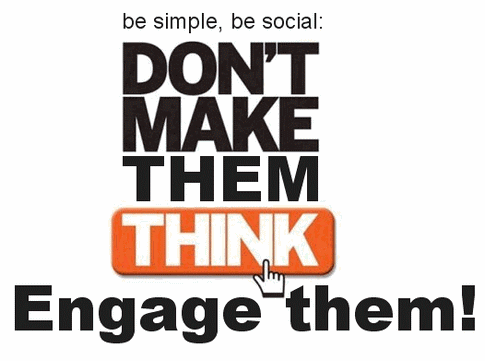
Should be used to provide a customer-engaged navigation path. This allows visitors to click through finding the information that interest them the most without forcing them to think. You want visitors to have a personal experience as they interact with your website. Remember: personalise services is the trend nowadays.


This video will concluded what we have been talking about, have a look...


To know the DIG MKT trends of the current year will give a broad idea of what is the audience looking for and help you to choose a base for your Website's design model, I found the list for this 2011 click here if you want to know.


Keep in mind that in today's society all of us want to feel that we have a personal treatment a good way of doing this is to open a dialogue, as soon as you remember this you will be fine!!
Do you have any good ideas of how to start a dialogue online? Any suggestions for our community guys feel free to comment :)
This is all for this week, hope this will help you, talk to you soon guys! CIAOOOO...
---
http://www.searchengineguide.com/stoney-degeyter/5-engaging-ways-to-engage-your-audience.php
http://econsultancy.com/uk/blog/7194-dont-forget-the-message-4
http://www.jack-marketing.com/index.php/Glossary/relationship-marketing.htm

Sunday, February 27, 2011

How to deliver projects on brief, on time & on budget.

Now that we know and understand how to start a digital marketing campaign according to my last posts, it is time to consider the technical aspects to make it happen: the time, the money and to make it concise.
First, we need to identify what is a successful project or what element does it contains?
According to the book Fast Forward MBA in Project Management in a successful project you can identify the following:

  1. Agreement on goals        
  2. A good plan
  3. Progress measurement
  4. Constant Communications
  5. Management Support
  6. Controlled scope
I found the article How to deliver Projects Successfully that describes 5 useful tips to accomplish your goals.

Now that we identify what do we need to create for a successful campaign, it is time for us to understand our project in order to put our hands on it and start working.


DEFINE WHY------> PLAN WHAT-----> PLAN HOW & WHEN  ------> DO IT!
                                                                                                        

What kind of project do we have? Do we have one that has an ending (Waterfall) or do we have one that the ending is hard to define (Agile)? These two project methods look like this:


WATERFALL                                AGILE


DEFINE

“Begin with the end in mind”
                        Stephen Covey
Start whit a Project Charter that will describe WHAT & WHY.
This charter will help to optimize:
  • Your communication and internal marketing tool
  • Build an active agreement and commitment
  • Force an initial scope decisions
  • Get management support and resources
In this step you will have to define all the elements of your company that will generate a spending. This way you will break down your entire budget and will be more visible for you where is the money going and for what, helping you to have track over it.

PLAN


An effective planning will reduce rework, in other words loosing time. That is why planning is a very important step in our process.
7 questions to create the Plan:
  • What are we creating?
  • What task must be done to create it?
  • Who will do what?
  • What will it take to do each task?
  • How do the task fit together?
  • What could surprise us?
  • How will we execute and control the project?
Here you will include a Timesheet document that will help to finish all your tasks on time and improve your time management. This Timesheet will describe what task has to do each one of your team members and when do they have to accomplish it.


EXECUTE & CLOSE STEPS

Check the Roadmap as much as you can just to make sure that everything has being done on time, according to the timetable we established in the beginning.


Hopefully this will help you guys, talk to you next week!

---
http://www.shawsystems.com/information/sevensteps.pdf
http://goliath.ecnext.com/coms2/gi_0199-6092293/Delivering-projects-on-time-risk.html
http://www.spspro.com/resources/Post-Deliv%20Prjs%20on%20Time%20and%20Budget-PMI%20Eugene%20Mar%2008.pdf

Sunday, February 20, 2011

MY FAVOURITE DIG MKT CREATIVE.

This week I will talk about my favourite marketing creative, in other words the idea that puts everything together for the campaign, so it can help you as an example for you projects guy. The Dove campaign for real beauty.
 Why is it my favourite? Well, because it doesn’t only promote a product and made profit for the company but tried to change a negative issue of nowadays society.
The campaign was launched in 2004 as a result of a study done by Unilever that said that only 2 per cent of 3300 women and girls from 10 different countries considered themselves beautiful and that 90 per cent will change something at least one aspect of their physical appearance, It was aimed to fight anorexia and low self-esteem in time where `skinny chic´ and size 00 was the height of fashion and where the sense of beauty was shift to an unreal one (to photoshop syndrome).


Dove marketing director Phillippe Harrouseau, after saw the results of the studies, concluded:
“It is time to redefine beauty! Our mission is to make more women feel beautiful every day by broadening the definition of beauty”.
The ad does not only promote Dove products but also their own fund the Dove Self-Esteem Fund .
Audience: All women.
Objectives:
  • Increase sales of Dove beauty and new product lines.
  • Create dialogue, debate, and discussion about the true meaning of beauty.
  • Create a call to action for consumers to join the movement through website.
Tactics:
  • Dove launched a global advertising campaign in Oct. 2004. The ads consisted on showing images of women that contradicted our idea of beauty.
  • Each ad directed the audience to the campaigns website www.campaignforrealbeauty.com.
  • TV commercials: Commercial aired during the Super Bowl 2006.


  • Website:

Audience can visit www.campaignforrealbeauty.com and participate in dialogues, discussions, and download research studies about beauty, and see what women around the world say about the subject.

  • Coverage in the news.
  • A commercial competition for Dove in 2007, the winner appeared in a famous TV show.
Evaluation:
• In the summer of 2005, the Dove campaign received nearly four hours of broadcast time. More than 60,000 people visited the CFRB Web site.

• During the summer of 2005, the campaign also secured coverage from 62 national television programs.
• CFRB also received feature coverage in high-profile print outlets, landing the cover of People magazine.The campaign received more than 1,000 placements in print, Web, television and radio, far exceeding expectations.

• The campaign generated more than 650 million impressions during the summer of 2005.

• According to Dove, sales for the products featured in the ads increased 600 percent in the first two months of the campaign.

• As of June 2005, more than 1 million visitors had logged onto www.campaignforrealbeauty.com and shared their thoughts about the campaign.
Awards.
  • PR Week’s Consumer Launch Campaign of the Year 2006
  • PRSA’s Silver Anvil ‘Best of’ Award 2006
  • Grand EFFIE Award 2006


But of course like in everything there is someone that tries to see the negative side on things, the campaign has received criticism for capitalising on women’s low self-esteem just to make profit and also they have said that even though they showed “normal” women they still being to head turners with smooth skin, straight teeth and no cellulite.
There is an article in the BussinessWeek  online version that criticises the campaign here is the link:  Surprise! Dove's "Campaign for Real Beauty" ads actually kind of fake


NOW IT IS YOUR TURN TO EXPRESS YOUR VIEW OF THE CAMPAIGN!!


http://www.media-awareness.ca/english/resources/educational/teachable_moments/campaignrealbeauty.cfm
Principles of Marketing Fifth European Edition Test Bank, 5/EPhilip Kotler,  
Gary Armstrong,  
Veronica WongAston John Saunders Financial Times Press
 2009.

Sunday, February 13, 2011

RIGHT CHANNELS FOR DIGITAL MARKETING


Digital Natives: The young generation that was born or grown surrounded by the digital technology, therefore it is natural for them.
This Modern society group has shifted their perception of identity and reality; a digital identity and an open participation has become an essential element to participate in almost every kind of online exchange. As a consequence, younger generations have changed their communication process for a shorter and faster way that makes it less personal.
You need to take this into consideration in order to get the right digital channels succeed in your digital strategy. You have to choose your channels and tools considering the needs and desires of digital identity, privacy, creativity, sharing and advocacy, in other words: engagement, enrichment and empowerment, that is what digital natives are looking for in the web.
“There are several layers to the changes we are witnessing captured in our report, from the behavior of individuals and their media consumption habits, through to new opportunities and threats to marketers and communicators as different digital challenges emerge and are adopted.”                                                                            Drew Benvie, managing director 33 Digital

The next video is a conference done by Professor John Palfrey explaining what is a digital native. 


In the blog Net Gen Skeptic there is an article that defines digital natives based on studies done in the UK.


TOP 9 DIGITAL CHANNELS
  1. Display Advertising: Placing ads on affiliate websites in order to create branding awareness and generate traffic. (Banner ads, video ads, interactive ads, overlays.)
  2. Email Marketing: collecting email addresses and send them email messages. (email newsletters, brand building emails)
  3. Pay-Per-Click Advertising (PPC): Bidding for placement at search engines to earn visibility and traffic. (Google, Yahoo)
  4. Online PR: Generating media from primarily online outlets to get branding and traffic. (PRNewswire, PRWeb, Internet media focused PR)
  5. Search Engine Optimization (SEO): earning rankings in the organic results of SEO. (keyword research, on-page optimization)
  6. Affiliate Marketing: Incentivizing other sites to push your product in exchange for share of the revenue. (Commission Junction, in-house affiliate programs)
  7. Social Media Marketing (SMM): To have visibility and more traffic through social media platforms. (Facebook Group pages, Twitter marketing)
  8. Viral Content Campaigns: Generating creative content that will spread your brand or product. (Linkbait production, viral videos, guerrilla marketing)
  9. Conversion Rate Optimisation (CRO): To convert audience in order to get more leads, signups, customers. (click-through-rate improvements, purchase-process simplification).
ARE YOU A DIGITAL MARKETING OR IMMIGRANT ?

    http://www.seomoz.org/blog/a-checklist-to-choose-which-internet-marketing-channel-is-right-for-your-business